
The Project for Reducing Ineffective Medicaid Expenditures (PRIME) was developed to help Medicaid leaders identify and address low-value care . PRIME focuses on Medicaid-covered services that may warrant coverage review because the available evidence suggests limited or no meaningful benefit relative to potential harms. Through evidence reviews, policy analysis and Medicaid data analysis, PRIME provides practical tools and examples to support evidence-informed decision making. Explore the PRIME framework, topic briefs, and state-focused findings to learn how Medicaid programs can identify opportunities to improve care and strengthen stewardship of public resources.
Why It Matters
The United States spends more on health care than any other highly developed nation, yet research suggests that a substantial share of spending goes toward services that provide little or no value to patients. According to the National Health Expenditure Accounts, US health care spending reached $5.3 trillion dollars in 2024, accounting for 18% of gross domestic product. Low-value care is estimated to account for roughly $100 billion in health care spending each year. As Medicaid programs face ongoing fiscal pressures, identifying and reducing low-value care has become increasingly important to ensuring that limited resources are directed toward services that improve health outcomes and deliver the greatest value. PRIME offers a practical framework and real-world examples to help states navigate these challenges.
What is low-value care?
Low-value care refers to health care services that provide little or no benefit to patients, may expose patients to unnecessary harm, or use resources that could be directed toward more effective care. Examples include services for which:
- No or little benefit for patients is provided
- The risk of harm is greater than the expected benefits
- An alternative treatment that is more effective or less harmful exists
- The expected benefits of the treatment do not justify the cost of the intervention
- The intervention is overused or used inappropriately
Start exploring:
- Learn about the PRIME Framework
- Review the four topic briefs
- Access state-by-state findings
- Explore the Center’s broader work in evidence-informed Medicaid policy
The PRIME Framework
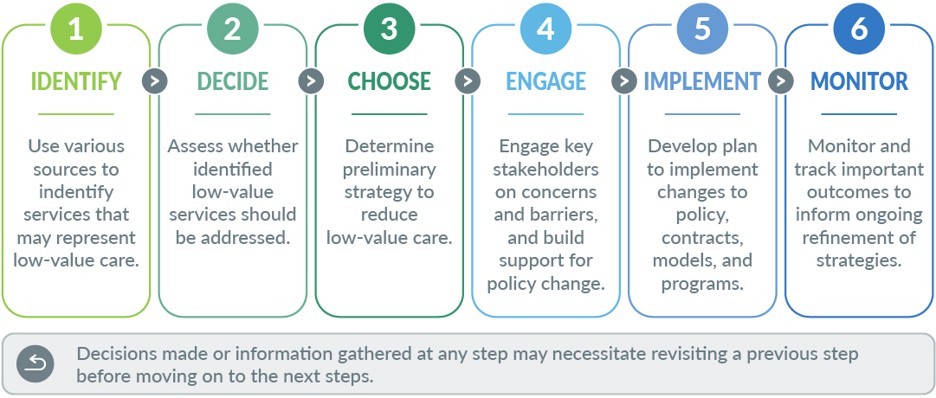
To help states identify and address low-value care, Center researchers reviewed the published literature and developed a practical six-step framework for evaluating Medicaid-covered services that may warrant coverage review.
The framework was applied to four use cases that illustrate how states can combine evidence reviews, clinical guidelines, payer policies, and Medicaid claims data to identify potential opportunities for improving value and stewardship.
PRIME Briefs
The PRIME project applied its framework to 4 use cases. Each brief summarizes the evidence, analyzes national Medicaid data, and highlights policy options that states may consider.
Brief 1: High-Complexity Genetic Testing
Genetic testing has grown rapidly, raising questions about utilization, spending, and potential fraud, waste, and abuse. PRIME identified approximately $147.8 million in national Medicaid expenditures for high-complexity genetic testing in 2024, with substantial variation across states.
Brief 2: Expanded Respiratory Panel Testing and Unspecified Infection Panel Testing
Use of advanced infectious disease testing has increased substantially in recent years. PRIME identified $282.6 million in spending on expanded respiratory panel testing and $186.5 million in spending on unspecified infection panel testing, despite concerns about limited evidence of benefit and potential overuse.
Brief 3: Residential Treatment for Opioid Use Disorder Without Follow-Up Medication
Clinical guidelines recommend medication for opioid use disorder as first-line treatment, yet many patients do not receive medication after discharge from residential treatment. PRIME found that nearly half of treatment episodes (49.1%) lacked follow-up medication within 30 days, representing approximately $353.7 million in national Medicaid expenditures.
Brief 4: Urine Drug Screening
Urine drug screening is widely used despite concerns about overuse and limited evidence supporting improved outcomes in some settings. PRIME identified approximately $245.2 million in spending associated with potential overuse, with considerable variation among states.